We build robots for dyson spheres
Frobotix makes robotics for space infrastructure, aimed at the star-circling structure Freeman Dyson proposed in 1960.

What a dyson sphere is
In 1960 the physicist Freeman Dyson wrote in Science that a civilisation using most of its star's light would surround the star with collectors. Those collectors would shed their waste heat as infrared, so astronomers could search the sky for it.
- 1960
Dyson's paper in Science
- Collectors
Around the star, catching its light
- Infrared
The glow to search for
Built around a star
Wrap a star in collectors and it changes how the star looks from far away: dimmer in visible light, brighter in infrared.
Read the questionsFour designs for a dyson sphere. Dyson himself ruled out the solid one.
-
01
A shell encloses the star
One solid sphere, the version science fiction made famous. Dyson later called a solid shell mechanically impossible.
-
02
A swarm circles the star
Many separate collectors, each on its own orbit. This is what Dyson said he meant, and it can grow one collector at a time.
-
03
A ring fills one orbit
Collectors share one band around the star, the plainest kind of swarm. Larry Niven's novel Ringworld made a solid band famous.
-
04
A bubble hangs on sunlight
Light sails called statites balance the push of the star's light against its gravity, so they can hover rather than orbit. Robert L. Forward patented the statite in 1993.
Nobody has built one yet
We're starting with the part that has to come first: machines that can work around a star with nobody there to help them. Here is what a swarm asks of its robots.
- Assembly
Collectors put together in space, part by part
- Inspection
Every collector checked, again and again
- Repair
Damage fixed where it happens
- Autonomy
Decisions made on the spot, far from any operator
Why a swarm needs robots
A swarm is a vast number of collectors, built far from Earth over many years. No crew can assemble or repair that many by hand. Machines have to, largely on their own, and that is the work we chose.
- Distance
- Radio moves at the speed of light, and light needs about eight minutes to cross from the Sun to Earth.
- Today
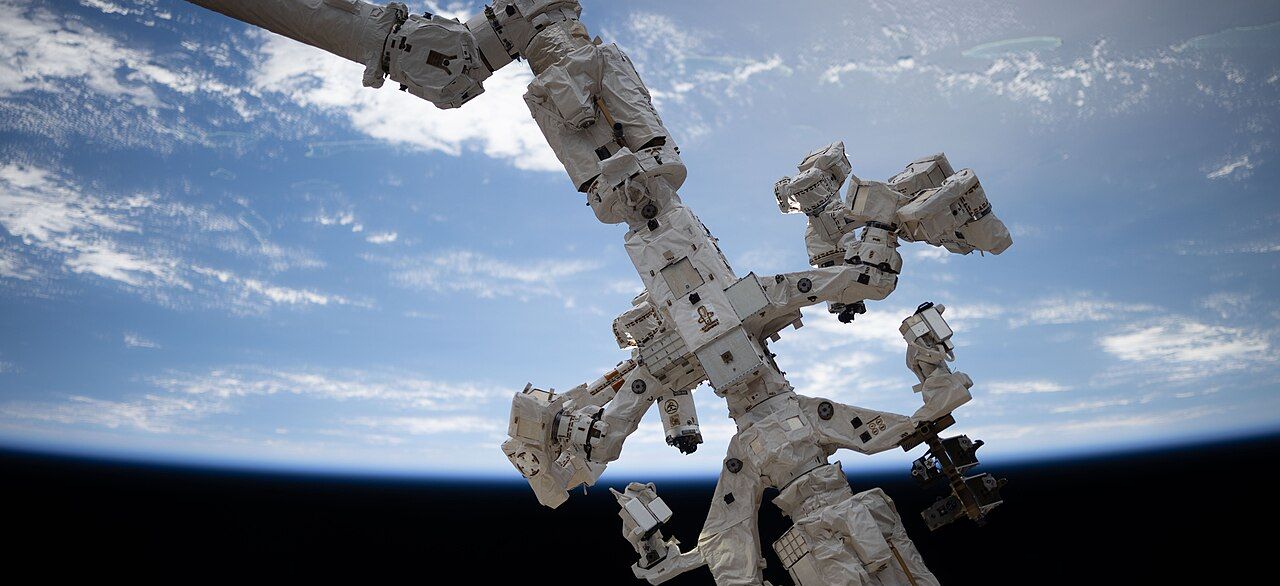
- The robot arms on the International Space Station are run by astronauts and by flight controllers on the ground.
- Scale
- The work grows with every collector added, far past what people could steer by hand.
Has anyone built a dyson sphere?
No. Astronomers have searched other stars and found candidates, none of them confirmed. Around the Sun, nobody has started. We want to.
Why would anyone build one?
To use far more of the Sun's light. Earth catches about one two-billionth of it; collectors around the Sun could take a far larger share.
What does Frobotix build?
Robotics for space infrastructure, with the dyson sphere as our goal: machines that can build and look after a swarm with no one beside them.
How do I reach you?
By email. Press Email Frobotix and write to us directly.